...an excellent writer and a good bloke.
Nobody deserves the stupid crap the morons have been firing at him.
It's a story. And it is a bloody good story. The fact that it generated such a fantastic level of emotion is a tribute to its quality. The fact that James has been forced to write this
http://jamesmoran.blogspot.com/2009/07/stepping-back.html
is a tribute too. Perversely.
I look at it this way: Torchwood Children of Earth was a very upsetting piece, it was real. The people in it behaved as people would. And it's not pretty.
In my opinion we all have bad things lurking inside, some of us can deal with it, we can acknowledge that under certain circumstances we might behave in bad ways, while hoping we won't. However those people who attacked James are those who cannot face the truth. They attempt to deny it by attacking the person who stood up and said "look, this could be you". (I know it wasn't just him but James has been the public face over the last week.)
Regardless of the type of attack, regardless of any so-called justifications for their attacks, it comes down to one thing: This TV show - this entertainment - threatened to show them what they were really like, and they couldn't take it, they had to lash out.
This is why there is no sense in trying to reason with them. For a start the thing they claim to be the problem isn't actually the real problem, and second, the damage has already been done and cannot be undone. They don't know what the problem really is, because if they did ... then it wouldn't be a problem.
RTD has done it before with Second Coming, though the reaction was less intense.
For what it's worth, James, I think you and the others created one of the best TV experiences I have ever had. It was utterly brilliant.
What's on the turntable? "When Tomorrow Comes" by the Eurythmics from "Revenge"
Showing posts with label james moran. Show all posts
Showing posts with label james moran. Show all posts
Sunday, July 12, 2009

Sunday, May 10, 2009
My body is my tool
(Title reference: "Not the Nine O'Clock News", Rowan Atkinson as the mime artist called "Alternative Carpark".)
Among all the forums, newsletters and blogs that I read about screenwriting, I've noticed a recent trend - the promotion and complaints about writing tools. Someone will say how a particular author's method for screenwriting is really great - so much better than Brand X. And then someone else will come back with how anything like this stifles creativity blah blah blah.
An instructive instance of this appeared on the "Artful Writer" forums only yesterday. I've just joined Artful Writer on a recommendation from James Moran , who had quoted an interview with Scott Frank. Someone had asked Scott whether any experienced and professional writers actually use the sequence approach to writing features, Scott was a little sarcastic in his first response. But a couple of postings later he said he'd check it out.
I use a lot of writing tools, mostly those from the book "Writing a Great Movie" by Jeff Kitchen. Apart from one, these tools weren't developed by him, they are things written by Aristotle, Polti and others. They actually include the so-called "Sequence method" but only as part of a bigger technique and without the more prescriptive additions that seem to have appeared.
I set great store by Aristotle (who never wrote a play), and this is why: Where Aristotle lived they had an annual play competition for which the subject matter was fixed - every play had to be about the same myth with the same characters. Aristotle observed that some plays were good and some weren't; and because they were all about the same storyline with the same characters he could separate out the plot elements to analyse them. Which is how he came to write the Poetics which describes the plot elements that existed in the successful plays.
I use writing tools that I know can help me put together a better story, and help me remove those things that won't work.
I remember when Desktop Publishing tools first appeared back in the late 80s. I was editor in a magazine publishing company at the time and our company was one of the first to move to computer-based layout. The layout and typography guys adapted to the new computer-based tools (mostly) and turned out better-finished work at a faster rate than previously. They were professionals and were now using better tools.
But the DTP revolution had another effect, obviously anybody could buy these tools - and they did - and they used them - but they had no training and usually no talent. And what they produced was garbage. They broke the rules of typography (like having a maximum of three font styles on a page) - because they didn't even know such rules existed.
Then companies began to include cookie-cutter designs with their software, for things like newsletters and pamphlets, so these untrained people could choose designs and fill them in - it meant that the designs looked reasonable. And yet, without a true comprehension of the rules of design and typography, these things are lacklustre. No sparkle. No real talent.
This is what happens with screenwriting.
You can follow McKee's monomyth for example and create a mythic story with all the right beats in the right places - even if you have minimal talent. The result will look like a proper story but it'll be lacklustre. No sparkle.
The thing is this: Each tool has its place, it has a purpose and an end product. But the tools themselves will not generate a good product. (You can't put an uncarved block next to a lathe and chisel, and expect to come back next day to find a beautifully turned chair leg. Not unless you know Rumpelstiltskin.)
If you are writing a story for which the monomyth structure is the way to go then fine. Utilise that tool to assist you in producing a better story. If you find that your story has illogical jumps and you can't quite make things connect use Jeff Kitchen's effect-cause tool to fix it. If you find that your protagonist does not engage with the reader, use Aristotle's Dilemma tool. Apparently the Sequence method is good for helping you through Act II and keeping things going.
But this requires you to know and understand the tools at your disposal. A professional does not reject a new tool out of hand, he checks it out, he sees if it will be useful. Is it a real tool, or just something someone's invented to make a quick buck? You can't know unless you look - which is why Scott Frank said what he said on Artful Writer.
I admit I do not understand people who reject all writing books, and other teaching, out of hand - it strikes me as ignorant. I have read Seger's books - I didn't like them and didn't feel they had anything to offer me. But I read them. Jeff Kitchen, on the other hand, provides a plethora of genuinely useful tools. (Apart from the character stuff - which I don't like and would never use. I have my own tools when it comes to character and have zero interest in pop psychology.)
I would contend that every professional writer (when I use the word professional I'm talking about attitude, not whether they've been paid for a script) has a toolbox. It might contain homemade tools, it might contain learnt tools, or a combination. But the toolbox is there - because writing is rewriting and when you are rewriting you're using something to analyse what's already been written and that something is a tool.
I must admit I have ended up saying something different to what I was going to say when I started - and I have convinced myself I need to read McKee and Campbell even if I never use them.
As a final note about the stifling of creativity: No tool will stifle creativity if used correctly. Just as woodworking tools are entirely safe as long as you understand them and how to use them.
In regard to Tec I didn't end up writing any scenes, I started an outline instead. I needed a different tool because stories of this complexity need to have their detail worked out first, otherwise they are not going to work.
PS: I'm not going to mention the Writer's Guild of Great Britain's special membership offer because everyone else has. (Doh!)
What's on the turntable? The Boy is playing "Yellow Submarine" on the saxophone...
Among all the forums, newsletters and blogs that I read about screenwriting, I've noticed a recent trend - the promotion and complaints about writing tools. Someone will say how a particular author's method for screenwriting is really great - so much better than Brand X. And then someone else will come back with how anything like this stifles creativity blah blah blah.
An instructive instance of this appeared on the "Artful Writer" forums only yesterday. I've just joined Artful Writer on a recommendation from James Moran , who had quoted an interview with Scott Frank. Someone had asked Scott whether any experienced and professional writers actually use the sequence approach to writing features, Scott was a little sarcastic in his first response. But a couple of postings later he said he'd check it out.
I use a lot of writing tools, mostly those from the book "Writing a Great Movie" by Jeff Kitchen. Apart from one, these tools weren't developed by him, they are things written by Aristotle, Polti and others. They actually include the so-called "Sequence method" but only as part of a bigger technique and without the more prescriptive additions that seem to have appeared.
I set great store by Aristotle (who never wrote a play), and this is why: Where Aristotle lived they had an annual play competition for which the subject matter was fixed - every play had to be about the same myth with the same characters. Aristotle observed that some plays were good and some weren't; and because they were all about the same storyline with the same characters he could separate out the plot elements to analyse them. Which is how he came to write the Poetics which describes the plot elements that existed in the successful plays.
I use writing tools that I know can help me put together a better story, and help me remove those things that won't work.
I remember when Desktop Publishing tools first appeared back in the late 80s. I was editor in a magazine publishing company at the time and our company was one of the first to move to computer-based layout. The layout and typography guys adapted to the new computer-based tools (mostly) and turned out better-finished work at a faster rate than previously. They were professionals and were now using better tools.
But the DTP revolution had another effect, obviously anybody could buy these tools - and they did - and they used them - but they had no training and usually no talent. And what they produced was garbage. They broke the rules of typography (like having a maximum of three font styles on a page) - because they didn't even know such rules existed.
Then companies began to include cookie-cutter designs with their software, for things like newsletters and pamphlets, so these untrained people could choose designs and fill them in - it meant that the designs looked reasonable. And yet, without a true comprehension of the rules of design and typography, these things are lacklustre. No sparkle. No real talent.
This is what happens with screenwriting.
You can follow McKee's monomyth for example and create a mythic story with all the right beats in the right places - even if you have minimal talent. The result will look like a proper story but it'll be lacklustre. No sparkle.
The thing is this: Each tool has its place, it has a purpose and an end product. But the tools themselves will not generate a good product. (You can't put an uncarved block next to a lathe and chisel, and expect to come back next day to find a beautifully turned chair leg. Not unless you know Rumpelstiltskin.)
If you are writing a story for which the monomyth structure is the way to go then fine. Utilise that tool to assist you in producing a better story. If you find that your story has illogical jumps and you can't quite make things connect use Jeff Kitchen's effect-cause tool to fix it. If you find that your protagonist does not engage with the reader, use Aristotle's Dilemma tool. Apparently the Sequence method is good for helping you through Act II and keeping things going.
But this requires you to know and understand the tools at your disposal. A professional does not reject a new tool out of hand, he checks it out, he sees if it will be useful. Is it a real tool, or just something someone's invented to make a quick buck? You can't know unless you look - which is why Scott Frank said what he said on Artful Writer.
I admit I do not understand people who reject all writing books, and other teaching, out of hand - it strikes me as ignorant. I have read Seger's books - I didn't like them and didn't feel they had anything to offer me. But I read them. Jeff Kitchen, on the other hand, provides a plethora of genuinely useful tools. (Apart from the character stuff - which I don't like and would never use. I have my own tools when it comes to character and have zero interest in pop psychology.)
I would contend that every professional writer (when I use the word professional I'm talking about attitude, not whether they've been paid for a script) has a toolbox. It might contain homemade tools, it might contain learnt tools, or a combination. But the toolbox is there - because writing is rewriting and when you are rewriting you're using something to analyse what's already been written and that something is a tool.
I must admit I have ended up saying something different to what I was going to say when I started - and I have convinced myself I need to read McKee and Campbell even if I never use them.
As a final note about the stifling of creativity: No tool will stifle creativity if used correctly. Just as woodworking tools are entirely safe as long as you understand them and how to use them.
In regard to Tec I didn't end up writing any scenes, I started an outline instead. I needed a different tool because stories of this complexity need to have their detail worked out first, otherwise they are not going to work.
PS: I'm not going to mention the Writer's Guild of Great Britain's special membership offer because everyone else has. (Doh!)
What's on the turntable? The Boy is playing "Yellow Submarine" on the saxophone...
Friday, July 04, 2008
Fiesta! Bonus Pics #2
You may wonder why I keep posting the pictures a day later.
Then again, you may not. Is it because I need to get the digital pictures developed first? Strangely, no. It's because I can only think about one thing at a time, being male, and when I'm writing my day report I just can't think about incorporating pictures.
 Picture #1 is very important. This is a picture of Stuart Perry having lost his voice. Oh yes. He's the chap in the middle, in case you don't know. Note clearly how he is not speaking.
On his left from our viewpoint is James Moran, writer of Severance and of Spooks, Dr Who and Torchwood episodes. While on his right is someone who's name I forget but he was a very nice chap. The table is littered with lunch.
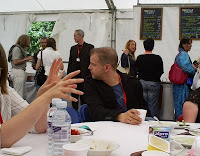 Next up we have an image of the majestic Nigel Planer standing in the food queue with no one talking to him. Apparently something is happening to the left of picture but I don't recall what that was.
Why is no one talking to him? Because they're too embarrassed because he's just so big, and tall as well. It's difficult being famous.
The red-head just right of centre is Joanne Leigh, winner of the Red Planet competition 2007.
 I thought I'd throw in this picture of the happy crowds of writers talking and chatting with all the news friends they've made over the last few days.
Most, like me, would not really have known anyone else and came, heart in hand, in the hope of meeting like-minded folks, the chance to learn some things about their trade and perhaps even make contact with a producer interested in their work. At the very least, you will make friends.
 This is my final image. It sums up the weekend. A game of croquet being played by Stuart Perry, Piers Beckley and friends. Life is like a game of croquet, on the surface it is a civilised activity involving balls and hoops; in truth it is a cut-throat endeavour with the participant's armed to the teeth with hammers.
What's on the turntable? "White Man" by Queen from "A Day at the Races"
Then again, you may not. Is it because I need to get the digital pictures developed first? Strangely, no. It's because I can only think about one thing at a time, being male, and when I'm writing my day report I just can't think about incorporating pictures.
 Picture #1 is very important. This is a picture of Stuart Perry having lost his voice. Oh yes. He's the chap in the middle, in case you don't know. Note clearly how he is not speaking.
On his left from our viewpoint is James Moran, writer of Severance and of Spooks, Dr Who and Torchwood episodes. While on his right is someone who's name I forget but he was a very nice chap. The table is littered with lunch.
 Next up we have an image of the majestic Nigel Planer standing in the food queue with no one talking to him. Apparently something is happening to the left of picture but I don't recall what that was.
Why is no one talking to him? Because they're too embarrassed because he's just so big, and tall as well. It's difficult being famous.
The red-head just right of centre is Joanne Leigh, winner of the Red Planet competition 2007.
 I thought I'd throw in this picture of the happy crowds of writers talking and chatting with all the news friends they've made over the last few days.
Most, like me, would not really have known anyone else and came, heart in hand, in the hope of meeting like-minded folks, the chance to learn some things about their trade and perhaps even make contact with a producer interested in their work. At the very least, you will make friends.
 This is my final image. It sums up the weekend. A game of croquet being played by Stuart Perry, Piers Beckley and friends. Life is like a game of croquet, on the surface it is a civilised activity involving balls and hoops; in truth it is a cut-throat endeavour with the participant's armed to the teeth with hammers.
What's on the turntable? "White Man" by Queen from "A Day at the Races"
Subscribe to:
Posts (Atom)